
FEATURED » WAR & PEACE
Nuclear factor: What keeps the world from the great war?
January 24, 2013 · 0 Comments
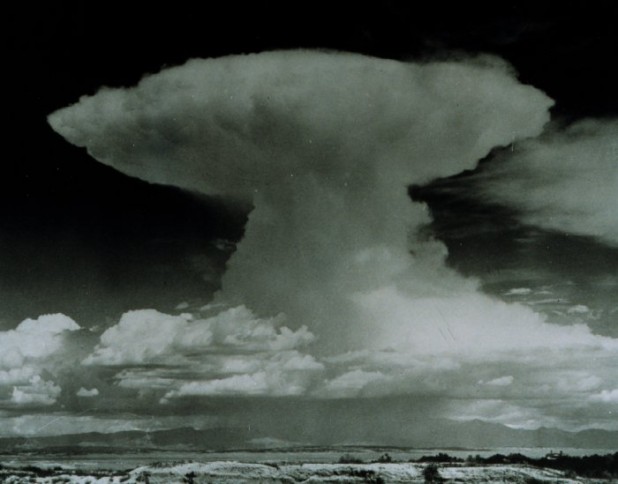
Nuclear deterrence is not an absolute guarantee against any war, as the history of post WWII decades shows. However, it continues to protect the world from war between the great powers. What is the role of nuclear weapons in recent history and will it continue to secure peace in the future?
For readers over 16 years old.
When talking about nuclear deterrence one should have in mind one fact which is as obvious as it is rarely mentioned. A key factor in nuclear deterrence is not even the presence of high-powered nuclear ammunition – to wipe out whole cities humanity learned without a nuclear bomb, but the presence of nuclear armed missiles. The difference between a nuclear bomb in the compartment of a bomber air plane and a bomb at the head of an intercontinental ballistic missile (ICBM) is very simple, namely, that massive raid with bomber air planes can be intercepted, a massive attack with ICBMs launch – not.
It is this indefensible hit, combined with it’s disastrous destructive power what makes nuclear missile force to an “Ultimate Weapon” like no one else. Today, however, the effectiveness of nuclear deterrence is often questioned (Nuclear skepticism).
“Nuclear skepticism” mainly is based on two postulates.
The first postulate derived from the history of the Second World War, when rich chemical stockpiles were accumulated by all major parties, but this fact did not played as a deterrent, and therefore did allow WWII to happen.
The second postulate is based on the premise that by itself the destructive power of a nuclear weapon does not solve anything – as already mentioned, mankind has learned to destroy whole cities without a nuclear bomb.
Both of these provisions are based on a false assumption.
Nuclear weapons compared formally side by side to the chemical weapons of mass destruction are fundamentally different in destruction capabilities and long-term consequences (it is not even about the radiation).
Chemical weapons, as the experience of the first world war (WWI) showed, have a very significant effect against unprepared enemy, but are far less dangerous if the opponent takes the basic protective measures. Therefore, in the presents of properly trained combat units against chemical warfare the use of chemical weapons was highly questionable, but on the other hand contributed to much increased bitterness of the opponents, who did not lose the ability to wage war.
To comprehend the difference between nuclear and chemical weapons, one need to understand that the main effects of a nuclear explosion is not ionizing radiation, followed by contamination, but the shock wave.
For this matter, the vulnerability of major cities since WWII only grew: the dependence of cities on power and water supply, information and communication systems makes them “ideal victims” even for low charges – the subsequent confusion and panic can additionally kill big part of population at the site of attack.
The possibility of the use of high-power charge provides precisely that effect, which is described in the press as “mutually assured destruction.”
Mutually assured destruction …
Speaking on the impact of the use of nuclear weapons one should always have in mind it’s instantaneous effect: In WWII time lapses between the massive air strikes allowed for enemy maneuver to occur, hereby partially or completely to eliminate or compensate for damage caused by the devastation, which enabled the opponent to continue the war.
A one-time surprising strike with the use of several hundreds nuclear weapons, each of which has the power tens times higher than of those bombs used in most destructive air raids in WWII combined, would result in a devastating effect by orders higher.
To compensate this magnitude of devastation will not be possible in short time if at all, especially because of the incapacitating effect on the industry, which would be needed for this purpose.
Nuclear war was planed …
At the beginning of the Cold War, the U.S. suggested that the military defeat and disintegration of the Soviet Union would require three hundred nuclear ammunition of the first generation (ranging from 10 to 30 kilotons). However, an insufficient number of such weapons first made such a strike impossible. Later, in the skies of Korea Soviet fighter aircraft capabilities convinced the U.S. that the probability of getting a successful nuclear attack based on classic bomber air craft would be very low.
Moreover, at the time when the U.S. received the first nuclear armed missiles, this weapon was then available to the Soviet Union as well – and it was during the Cuban missile crisis that the new reality was suddenly realized: John F. Kennedy, of course, understood that the United States could destroy the Soviet Union. However, even an order of magnitude less powerful Soviet retaliation could have already killed tens of millions of U.S. citizens, and this would be with a very high probability the end of the United States.
No victory – no war …
The impossibility of victory in a nuclear war, which came to be understood just then, was the basis for the subsequent coexistence of the USA and USSR.
This situation is today even more affirmative: the more advanced a country is, the more damage will a nuclear attack cause, and the more retardation the devastation will bring.
The awareness of consequences of a nuclear war secures the peace …
Awareness of the effectiveness of nuclear deterrence is the best guarantee of peace among the great powers, but it is fraught with the constant desire to protect itself from nuclear attack.
And the greatest danger of missile defense systems is by no means a real chance to intercept a strike, but their psychological effects.
The danger lies in wrong imagination …
Overestimation of it’s own abilities has often pushed rulers in the past to adventurous steps, but adventurism in the nuclear age bears the risk, that the perpetrators may not be hold accountable for its deeds due to subsequent numerous small wars for surviving, for supplies of food, for water sources and medicines of the remaining population.
The power of nuclear weapons and the possible consequences of its use are probably the best argument in favor of abandoning nuclear deterrence altogether, especially in the age of proliferating local wars, but, unfortunately, “nuclear deterrence factor” continues to dominate as means to prevent major wars. We may only hope that one day the mankind will mature to a degree so peace can be maintained in other way than under the threat of mutual destruction.
By Ilya Kramnik
http://rus.ruvr.ru/radio_broadcast/88116651/98007624.html
Translated from Russian
Tags: Society , in Russia , the Russian service , chemical weapons , Overseas , History , USA , Cold War , ICBMs , nuclear deterrence , Ilya Kramnik , weapons , aviation , USSR , World War II , weapons of mass destruction
By myfuamerica
Sorry, comments are closed on this post.