
EUROPE » FEATURED
Germany’s Spiegel, Crudest Propagandists Newspaper Retracts Step By Step From Illicit Russia Bushing
December 1, 2014 · 0 Comments
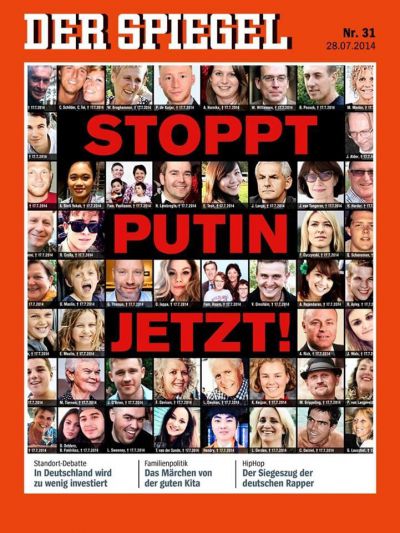
The magazine which had been the forerunner in the anti-Putin hysteria now critiques German miscalculation and failure in Ukraine
Robert Parry (Excerpt)
GERMANY 1 hour ago | 188 0
Der Spiegel in July
Robert Parry picks up on something we have reported ourselves.
This is an excerpt from an article that originally appeared at Consortium News
Last summer, the German newsmagazine Der Spiegel was swept up in the Western hysteria over Russian President Vladimir Putin and the Ukraine crisis, even running a bellicose cover demanding “Stop Putin Now” and blaming him for the 298 deaths in the July 17 crash of Malaysia Airlines Flight 17 in eastern Ukraine.
However, in October, Der Spiegel quietly reversed itself regarding Moscow supposedly supplying the Buk missiles, reporting that the German foreign intelligence agency, the BND, had concluded that Russia did not supply the battery suspected of bringing down the plane, saying the plane was shot down by a Ukrainian military missile captured by the rebels from a Ukrainian military base (although I was later told by a European official that the BND’s conclusion was less definitive than Der Spiegel reported).
In another reversal of sorts, this leading German-language newsmagazine has acknowledged that the European Union and German leaders were guilty of miscalculations that contributed to the Ukraine crisis, particularly by under-appreciating the enormous financial costs to Ukraine if it broke its historic ties to Russia in favor of a new association with the EU.
In November 2013, Ukraine’s President Viktor Yanukovych learned from experts at the National Academy of Sciences of Ukraine that the total cost to the country’s economy from severing its business connections to Russia would be around $160 billion, 50 times the $3 billion figure that the EU had estimated, Der Spiegel reported.
The figure stunned Yanukovych, who pleaded for financial help that the EU couldn’t provide, the magazine said.
Western loans would have to come from the International Monetary Fund, which was demanding painful “reforms” of Ukraine’s economy, structural changes that would make the hard lives of average Ukrainians even harder, including raising the price of natural gas by 40 percent and devaluing Ukraine’s currency, the hryvnia, by 25 percent.
With Putin offering a more generous aid package of $15 billion, Yanukovych backed out of the EU agreement but told the EU’s Eastern Partnership Summit in Vilnius, Lithuania, on Nov. 28, 2013, that he was willing to continue negotiating.
German Chancellor Angela Merkel responded with “a sentence dripping with disapproval and cool sarcasm aimed directly at the Ukrainian president. ‘I feel like I’m at a wedding where the groom has suddenly issued new, last minute stipulations,” according to Der Spiegel’s chronology of the crisis.
“In one of the most important questions facing European foreign policy, Germany had failed,” Der Spiegel admitted in its review of how the crisis evolved from the botched negotiations a year ago.
The magazine cited a speech last December by the new Foreign Minister Frank-Walter Steinmeier, saying:
“We should ask ourselves … whether we have overlooked the fact that it is too much for this country to have to choose between Europe and Russia.”
Der Spiegel also quoted a key figure in the Ukraine talks, European Commissioner for Enlargement and European Neighborhood Policy Stefan Füle, as conceding that the EU confronted Ukraine with an impossible choice.
“We were actually telling Ukraine …: ‘You know guys, sorry for your geographic location, but you cannot go east and you cannot go west,’” Füle said.
“More than anything, though, the Europeans underestimated Moscow and its determination to prevent a clear bond between Ukraine and the West,” Der Spiegel wrote.
“They either failed to take Russian concerns and Ukrainian warnings seriously or they ignored them altogether because they didn’t fit into their own worldview.”
This more tempered assessment by Der Spiegel – though a marked improvement from the hysteria of last summer – still falls far short of the highest standards of journalistic objectivity.
But it suggests that perhaps a more rational attitude toward the Ukraine crisis is finally taking hold in Europe.
By myfuamerica
Sorry, comments are closed on this post.