
FEATURED » WORLD
What’s happening in Georgia?
August 13, 2013 · 0 Comments
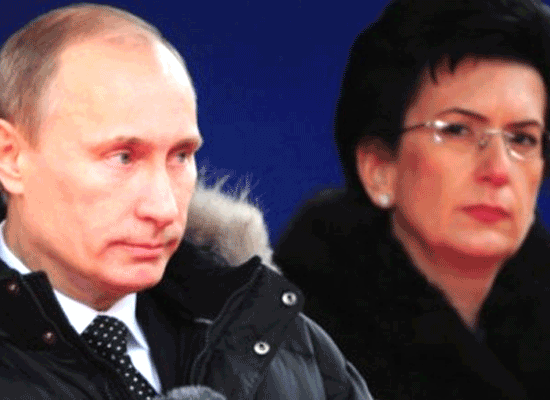
Putin and Burdghanadze
The first point: the reality in which there was a modern Georgia. On the “junction” transfer of power between last year’s upcoming parliamentary and presidential elections, again here regularly returned political instability and the accompanying uncertainty.
The old authoritarian system of government, which was built under the vertical President Mikheil Saakashvili has already been destroyed. However, the new system is built on the basis of the now ruling coalition “Georgian Dream” led by Prime Minister Bidzina Ivanishvili, still has not appeared. Saakashvili’s team desperately clings to the rapidly diminishing her authority, acting as the main destabilizing factor. In addition, the uncertainty of the election strengthened the premiere of Ivanishvili’s statement of readiness to resign by the end of this year. And this statement Ivanishvili does have several times since the victory of the “Georgian Dream” on last year’s parliamentary elections.
However, if the current main rivals Saakashvili and Ivanishvili’s gone, what’s going to happen in Georgia? Who comes to the management of the country after the next presidential election?
In addition to political uncertainty, we also note the harsh reality of the worsening socio-economic situation. Georgians is now the most sensitive feeling in their pockets: life has become worse, heavier, miserable wages, prices are rising, the country’s development stalled, stopped numerous construction. Of course, the Georgians have no “illusions” of Mikhail Saakashvili, whose party in last year’s October elections has already received a voter resounding “no.” At the same time, the big question is, will meet the expectations of the “Georgian Dream” form a ruling coalition?
The conclusion is that the political and economic instability are the main challenges of modern Georgia, increasing social tensions, anxiety, apathy, fatigue. Where does the modern Georgia?
The second point: the lack of a national unity.
Georgia remains stable is divided in several “lines” artificially created “split”. For example, along the West / East: Western Georgia (Kutaisi) strong positions in “otsnobistov” (Georgian: “dreamers”, supporters of the “Georgian Dream”) in eastern Georgia (Tbilisi) is trying though, bit by bit to restore its former influence Saakashvili. In western Georgia, the majority of the population prefers to good neighborly relations with Russia, rather than European integration with the United States and the European Union. While in the East are strong nationalist sentiment. In addition, there is a terrorist threat. It has long been no secret ties with Saakashvili and other North Caucasian Chechen guerrillas.
Another line of discharge “split” is purely a domestic nature – between supporters of Saakashvili and Ivanishvili. Georgians delved into petty domestic disputes, forgetting that every split only weakens the country and makes it vulnerable to the influence of external forces.
United States, for example, have long played such a dissociation in betting on a weak, unpopular, but very ambitious Saakashvili. The unpopular leader has just annoys people and reduces the level of confidence in the government. In turn, the leader who does not have support in their own people, it becomes a puppet of external forces, with all the ensuing consequences. In addition, the setting of artificial split allows the U.S. to try to at any time to try to destabilize the situation in the country. That, given the geopolitical situation of Georgia creates the preconditions for the destabilization of the situation in the entire Caucasus region, with the main gun against the interests of Iran and Russia. And so it turns out: U.S. popolzovavshis Georgia, where there was a puppet in the power of Saakashvili. And now continue dozhevyvat crumbs, trying to finally ignite the whole of the Caucasus (for covering up traces?).
Russia, incidentally, also plays on the internal disunity in Georgia. First, Moscow has no other choice: their political influence with her in Georgia is long gone. So, it remains to maneuver between the existing players. Second, the split – it’s a great opportunity to reduce the power of Saakashvili to then trimmed the field to bring to power forces loyal to Russia.
Hence the second conclusion: the Georgians without national unity is unlikely to achieve political and economic stability. That, in turn, will continue to keep the country on the brink of renewed conflict, undermining and expanding company. Of course, attempts to create an environment of controlled chaos is most advantageous “National” Saakashvili. (Another issue is that to control the situation in the “nationals” each time it turns more and more difficult).
The third thesis: the weakening of the geopolitical “anchor” of Georgia.
Former unidirectional strategy Saakashvili was based on two assumptions – in the United States to obey and do any mischief Russia. In addition, Georgia immaculately performed any recommendations Western (EU, Turkey and Israel), without regard to the Georgian national interests. Saakashvili chose the easiest way, preferring to work on a national strategy, coarse rip-off someone else’s experience, with all its faults and failings.
However, such devotion Washington protege never really appreciated. And in the most critical periods of the United States at all times left Georgia a one-on-one with many challenges. For example, in August 2008, the United States failed to meet expectations Saakashvili, without entering into conflict with Russia in defense of Georgia. But now Washington, given its own economic problems, certainly not up to Georgia. Especially since the U.S. general review and optimize their impact on the world, draining even his closest allies. And Georgia, in turn, to those “closest allies” did not apply and is not applicable (no matter how Saakashvili tried to curry favor with the “Uncle Sam”).
The EU, too, is not up to Georgia. Moreover, that the position of Brussels in the Caucasus policy were initially the weakest in comparison with the other players.
Turkey – one more hope, support Saakashvili – strong Syrian coerced “nut”. Well, Israel is more concerned with the changing Middle East situation.
At the same time, the opposite “Atlantists” Eurasian vector Georgia still ragged. For example, just now seen by Tbilisi fragile attempts to strengthen relations with China.
Well, with Russia, Georgia is known, the situation of acute territorial conflict. After coming to power of “Georgian Dream” Tbilisi has already made some steps towards Russia. In Moscow, it moves seen heard messages of the friendly, but still retaining the position they occupy.
The conclusion is that in a changing geopolitical realities of Georgia was a vacuum. That, in turn, only increases the discharge situation of chaos.
The fourth thesis: an alarming situation in South Ossetia. There is the repeated attempts of the discharge of the situation in the region, so as to again provoke renewed fighting.
DipComment already wrote about the threats of the “Caucasian redistribution.” For example, on August 11 the Georgian Interior Ministry, once again, recorded a gunshot fire on the other side of the South Ossetian “border”. And it’s not the only such fact.
Who benefits? First of all, Mikhail Saakashvili, who is trying by all means to keep in power. Even at the cost of the final split of the country. However, there are also some corrupt elites in Russia and their puppets out of Tskhinvali, which traditionally are cashing in on aid for the “restoration” of South Ossetia.
By the way, Georgia will be able to ignite a fire in another conflict – it is a question of influence of these destabilizing forces. In the meantime, as we see, Saakashvili more wishful thinking.
The fifth point: the basic course of events in Georgia is tied to the date of the presidential elections, which are scheduled on October 27. However, the plot is not in the elections as such specified date – is the deadline for Mikhail Saakashvili, who finally liberate Georgia from its dictates and leave in history. (But not with the best memories).
At the moment, the country is still not visible any signs of pre-election rush. For example, there is no pre-election billboards (which previously loved to flaunt Saakashvili – even in the post-election period), nor any other signs of agitation work. Not deployed as the activities of the election headquarters of candidates. It is clear that the official start of the campaign for the law has not yet begun. But we are now talking about the actual start of the campaign.
However, in this case we take into account, first of all, the realities of the Georgian constitutional reform that after the elections finally come into force and will reduce the price of the presidential office. Georgia will become a parliamentary-presidential republic, where the center of power will shift to a parliamentary coalition, headed by the Prime Minister. Revisit the constitutional reform will not succeed: the ruling coalition has only a simple majority, but there is no constitutional two thirds. Canceled if the reform through the Constitutional Court, following the example of Ukraine? Given the fact that Saakashvili actually originally held constitutional reform by itself, thus attempting to extend his stay in power.
Roughly in the presidential race will take about 30 candidates. Nominal favorite – George Margvelashvily. On August 12, he actually began his campaign after Bidzina Ivanishvili formally presented his Georgian voters as nominee of “Georgian Dream”. (Note: the official registration of candidates will start from September 7). However, Margvelashvily actually be able to count unless, on the administrative resources and bind to the rated Ivanishvili. While the authorities in Georgia have traditionally unpopular among the public. In addition, Margvelashvily, though honorable man, but is little known and has no charisma.
The pro-Western parties, on the other hand, with his protege still can not decide. For example, was not averse to try presidential war “hawk” Alasania, but it is on this account has not taken a final decision. While the young “National” Dato (David) Bakradze more determination. However, the chances of “winning” are minimal, and his participation – nominally. Note that for the “nationals” is a forced bet. Given the fact that their leader Saakashvili – “lame duck” and its nearest “changer” (Interior Minister) is in custody awaiting trial in a criminal case.
In any case, hardly pro-Western forces in general will be able to win the Georgian elections. In this situation, most likely will be the candidate who will be able to enlist the support of Russia. Given the markedly increased influence of Russia in Eurasia. In particular, its dominant position in the Caucasus. At present, Russia – the most influential player in the region.
However, Moscow so far in Georgia “game” is still highlighted their “card”. In part due to the ability of the Russian leader Vladimir Putin beautifully withstand pause. But it is possible that the Russian Federation is dictated by prudence and not to spoil the chances of his proteges. Given the fact that especially after the August-08 every “pro-Russian” in Georgia has become akin to political death for any candidate. (However, this rule applied in the exclusive authoritarian dictatorship Saakashvili, who has made anti-Russian propaganda by one of the pillars of his power. While now the situation has changed in the country). Moreover, the limited impact of the Russian influence in Georgia.
In a situation where the new Putin “bets” No, it makes sense to look at the “rates” are old. All the more so after the August Russian Federation are temporarily froze its Georgian game. Well, at the last presidential election held in 2008, in the interests of Russia was tactically advantageous Nino Burjanadze, who at that time as the leader of the “united opposition” has been the main alternative to the “Saakashvili regime.” In particular, Nino Anzorovna was even repeatedly awarded an audience with Russian President Vladimir Putin.
In 2008, Mikhail Saakashvili, as we know, it was possible at the cost of massive rigging of votes to secure a second term, and the shock of the post-war soon followed the August conflict at all possible to correct the monopoly in the country, using the technology of intimidation and police diktat. Now, such a “tool kit” is exhausted, the passion and hysteria subsided, Saakashvili cornered, and therefore it makes sense to go back to the old patterns.
Note Nino Burjanadze is currently the only major politician in favor of the Georgian-Russian dialogue and strategic compromise with Moscow. “I do not see any candidate who would have more advantages in office than there is in me” – immodestly described his chances Nino Burjanadze, the Russian Service RFI (August 9).
And here it is possible to trace the logic of Putin’s game: it turns out, the sole purpose of joining a businessman Ivanishvili policy in 2012 was to remove Saakashvili from power. And it was a forced move. Without their own players in Georgian politics, Moscow was forced to use a representative business environment. In order to a complicated and convoluted mnogohodovki lead to power Nino Burjanadze.
As a result, Putin’s task, which for various reasons failed in 2008, became a reality five years later. And Vladimir Putin has proved in practice: the time the policy is not an obstacle, the most important thing – perseverance, will and determination. Unattainable goals do not happen.
… However, Burjanadze victory in the elections will not bring more certainty to the “Georgian party”.
1. Burjanadze agree to be content with the realities of constitutional reform that would cut presidential powers?
2. Will Burjanadze agree with Bidzina Ivanishvili, whose party controls the parliamentary majority? What will be the content of such an agreement?
3. Who will be the new Prime Minister of Georgia from the perspective of Ivanishvili has announced the resignation from the post?
4. What will happen to the constitutional reform and the system of government which, ultimately, will be formed in Georgia?
The general conclusion: Georgia is on the verge of moving to a new stage of its development.
Will Saakashvili in the remaining months of his term at the cost of destabilizing try to turn the tide in their favor or finally manage to secure his victory by his opponents – will show further developments.
As for the prospects of Georgian-Russian relations, yet there will be respected tactical pause time. Most likely, after the forthcoming Winter Olympics in Sochi in 2014, relations between Moscow and Tbilisi are noticeably more active. Many of the challenges to finally find their solution.
Automatic translation from Russian
By myfuamerica
Sorry, comments are closed on this post.