
FEATURED » WORLD
‘I don’t recommend the US to adopt strategy of serious support for the rebels’ – Israeli expert
July 15, 2013 · 0 Comments
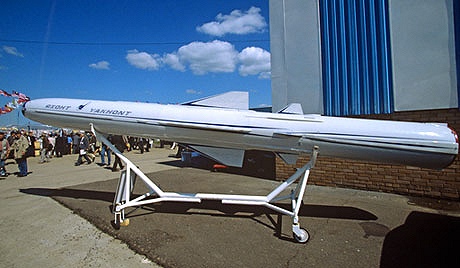
Yakhont anti-ship missiles
Photo: RIA Novosti
Israeli submarines could have carried out the July 5th attack on an arms depot in the Syrian Latakia port, that’s according to the Sunday Times. Over the weekend US officials announced that it was Israel’s Air Force that was responsible for the attack. The operation allegedly targeted Russian-made Yakhont anti-ship missiles. The Voice of Russia discussed this accident with Shlomo Brom, Senior Research Fellow at the Institute for National Security Studies in Israel.
Israel previously struck in Syria at least three times this year. In May, it launched two airstrikes on Syrian territory. One of the strikes was thought to be on the country’s Scientific Studies and Research Center, which was previously attacked by the Israeli Air Force in January. Another attack, which took place on May 3, targeted surface-to-surface missiles provided by Iran and based at the Damascus International Airport.
The July 5th attack allegedly targeted a contingent of 50 Russian Yakhont anti-ship missiles that had reportedly arrived earlier this year to support Syrian President Bashar Assad’s regime. The Times cited a Middle East intelligence source as saying that the Israeli fleet of German-built Dolphin-class submarines launched a cruise missile at the weapons cache.
Syrian rebels said that they were not responsible for the explosions. According to the rebels, the scale of the blasts was beyond the firepower available to them, but consistent with that of a modern military like Israel’s.
Israel has neither confirmed nor denied involvement in the attack. However, Israeli Prime Minister Benjamin Netanyahu spoke out about the attack on Sunday, insisting he would not allow “the transfer of dangerous weapons to Hezbollah in Lebanon,” in an interview with CBS, while still refusing to confirm whether the country played a role. Other Israeli officials took a similar stance.
The Syrian government has not made any official comments on the incident.
Meanwhile the US appears to be limiting its arms supplies to Syria. That’s according to the New York Times. Washington’s plans call for the C.I.A. to supply only small arms, and to only a limited segment of the opposition. The actual numbers of weaponry are unrevealed.
Mr. Brom, reports say the mysterious explosions that shook the Syrian village of Asamiya some 20 kilometers northeast of the coastal city of Latakia early on Friday July 5th destroyed a Syrian arms depot, killing at least 10 government troops. Do you have confirmation of these reports?
I can not confirm because this kind of military operations are secret and not open to the public. But my assumption is that this attack took place because of the leaks from Washington. I mean the media caught an American official that actually confirmed that this attack took place.
Who is responsible for this attack in your opinion?
I don’t know who is responsible for this attack but we have to analyze the interests of different players. It makes sense that they will be interested in the destruction of this weapon system because they are the cause of their concern.
Now to the crux of this interview. Syria’s Assad regime has two strategic opponents in its immediate area, the Syrian rebels and Israel. The Free Syrian Army boasts it fired the rockets that destroyed the depot. Last Friday, the CNN quoted an unnamed US official as saying that the rockets were fired by Israeli jets. And the latest Sunday Times said they were in fact cruise missiles launched by Israeli Dolphin-class submarines. Are you in a position to bring clarity to the matter? Who on earth was behind the attacks? Was it the Free Syrian Army or Israel? If these reports are confirmed, what could the consequences be for Israel?
I will start by saying that I don’t believe in that the opposition forces you saw in this depot because the weapon systems in this kind of depots are kept in shelter that are made of fortified concrete and I don’t think that the rebels have rockets with warheads that can destroy this kind of shelter. One needs a firepower for that. Because of that I think that the assumption that Israel might be involved in it is reasonable assumption.
Is there any truth in reports that the Latakia depot was storing about 50 Yakhont anti-ship missiles supplied to the Assad regime by Russia? Is there a connection to Israeli fears that weapons held by the Assad regime may find their way into the hands of Israel’s arch-foe Hezbollah?
I don’t know specifically about this facility because you know one needs to have very accurate intelligence to know this kind of information. But Latakia is a base of the Syrian navy and it makes sense that this kind of weapon systems would be stored there.
Should America supply weapons to the opposition in your opinion?
I think that the present US strategy or policy doesn’t make a lot of sense because the main problem is what is the best way, the optimal way of stopping this craziness, of stopping the civil war in Syria that causes so many losses of lives. Supply of limited amounts of weapon systems to the opposition will not achieve this goal. So, the US has to choose between 2 possible strategies. One of them is to try and find political solution together with the other powers, for example Russia but also Iran etc. to the civil war. The other possible strategy is to give real assistance to the rebels and to enable them to be victorious in this civil war.
The point is nobody knows who the rebels are at this point and that is why America is limiting its support because nobody knows who the opposition is composed of. There are so many different groups and the fear is that the arms may end up in the wrong hands.
I think at this stage of the years of fighting there is sufficient information about the different groups that are participating in this civil war. I am not recommending the US to adopt the second strategy of serious support for the rebels, but what I am saying is that the US has to choose between these 2 strategies and not what it is doing now.
By myfuamerica
Sorry, comments are closed on this post.