
WORLD
Russia, Japan find the road map for normalization after WWII.
May 5, 2013 · 0 Comments
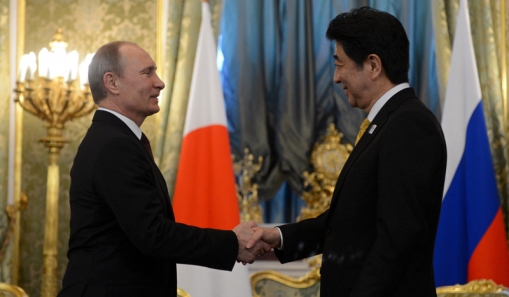
President Putin is to visit Japan. The Russian leader accepted an invitation extended by Prime Minister Shinzo Abe when he was in Moscow on Monday and Tuesday on the first visit to Russia by a Japanese government head in 10 years.
This is what Vladimir Putin had to say at the closing news conference:
“We have agreed to resume diplomacy towards a formal postwar treaty of peace. Bilateral disagreements have been holding it up for 68 years. This means we cannot expect quick progress on the matter. At the same time, the importance of this problem for both countries makes it necessary to have it solved.”
Mr Abe agreed:
“The situation in which 68 years after the end of the latest military conflict between them our countries are still technically at war should be seen as abnormal. Unfortunately, no magic can resolve this problem at once. Our Moscow meeting, however, has restarted the bargaining process.”
The main obstacle to the sought after peace treaty is the dispute over who owns the South Kuril Islands, which became Russian under the international agreements signed at the end of WWII.
Dr Viktor Pavlyatenko of the Far East Institute of the Russia Academy of Sciences draws a parallel to Japan’s dispute
with China over the Senkaku Islands in the East China Sea:
“In both cases, confidence building and a comprehensive dialogue are the best way to find a mutually acceptable solution. China shares this approach with Russia. Both countries offer Japan substantive talks on territorial issues.”
Russian Foreign Minister Sergey Lavrov called attention to the economic side of Mr Abe’s visit:
“The fact that Mr Abe brought 120 business executives from all industries shows that Japan has concrete plans to build long-term and far-going economic exchanges with Russia.”
He said the two countries now have a road map of cooperation building.
Now that Fukushima has forced Japan to suspend nuclear energy generation, Russian oil and gas are the most important cooperation areas.
Dr Konstantin Simonov heads the Moscow-based National Energy Security Foundation:
“Japanese companies mull acquiring stakes in Russian gas development projects and investing in a big LNG plant in Vladivostok. Gazprom, in return, is seeking stakes in LNG terminals and gas distribution networks in Japan.”
Shinzo Abe laid a wreath to the Tomb of the Unknown Soldier and presented Vladimir Putin with a pair of alpine skis.
Dr Valeri Kistanov offers an interpretation of this ski symbol:
“Putin is the top sponsor of the 22nd Winter Olympics, to be held in Sochi in February 2014. For this reason, the gift of alpine skis should be seen as a gesture to express a desire that the Sochi Olympics be a resounding success.”
Putin presented Abe with a bottle of wine of 1855 vintage. The year 1855 brought the first trade and friendship treaty between Russia and Japan.
Alexei Lyakhov, Konstantin Garibov
english.ruvr.ru
By myfuamerica
Sorry, comments are closed on this post.