
FEATURED » WAR & PEACE
This is the beginning of Cold War! The Russian Bear is injured! America’s white glove is on the floor …
April 2, 2013 · 0 Comments
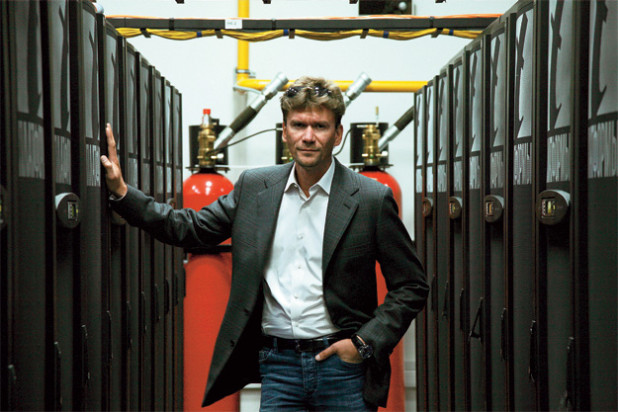
General Director of “T-Platforms” Vsevolod Opanasenko and supercomputer “Lomonosov”
Russian developer and manufacturer of supercomputers “T-Platforms’, that has made a successful expansion into the global market, is being placed on the American blacklist. Now it’s business is at risk, and even much, much more!
The U.S. bureau of Industry and Security (BIS), under the Ministry of Commerce, March 8, announced the inclusion of the Russian company “T-Platforms” and its two subsidiaries in Germany and Taiwan in the “list of organizations and persons acting contrary to the national security and foreign policy interests of the United States” .
In October last year, the list has included companies from around the world involved in, as Americans say, illegal supply of electronic components from the United States to Russia. The difference is that those punished last year were the distributors of electronic components, and the “T-Platforms” – Russia’s largest manufacturer of supercomputers, whose activities are of strategic importance for the country.
More major Russian companies are on the list as well, like Scientific Research Institute of Technical Physics, Snezhinsk and Institute of Experimental Physics in Sarov, which are world-renowned Russian nuclear centers.BIS noted hereby: “The Bureau has reason to believe that the company” T-Platforms “dual-use items exported without the necessary license, and that the company’s activities related to the development of computer systems for military purposes and the production of computers to nuclear research.”Turning to the black list means that the company is established “presumption of prohibition” to obtain licenses to export, reexport, or transfer of any goods or products manufactured in the U.S. or to U.S. technology in other countries.
Restrictions imposed by closing opportunities not only for the purchase of electronic components in the United States, but also to order chips, independently developed by specialists of “T-Platforms,” on any factory of the world, because all the factories use U.S. technology.
“Roughly speaking, we can not buy sunflower oil, if the square on which grows sunflower pollinated American pesticides” – says CEO and co-owner of Vsevolod Opanasenko. For “T-Platforms” means the actual “prohibition on trade”: without proper components, the production of which is under full American control, the creation of supercomputers impossible. Moreover, “the ban on trade” is not limited to the company itself, but also for its top managers, as applicable for all companies of similar profile, created with their participation.
Supercomputers and “T-Platforms”Supercomputer called computers with tremendous computing power, which is measured in the number of floating point operations per second (FLOPS, flops).
These machines are used to predict weather and climate conditions, simulations of nuclear tests, tests of various equipment – aircraft, automotive, to model the life cycle of nuclear fuel elements.
They are used in the design of fission and fusion reactors, to analyze the data exploration in the search and evaluation of oil and gas fields, for decoding DNA.
In other words, supercomputers are needed, where to meet the challenges to numerical simulation, or where required a huge amount of complex calculations, processing large amounts of data in real time.Director of the Institute for System Studies of RAS Academician Vladimir Betelin back in 2009, in an interview (see “No supercomputer – go to market” in “Expert» № 37 in 2009) was confident that in the near future the main consumers aircraft one of the conditions of delivery will make the presentation of simulation results liner.
And all those who do not have such a model will be squeezed out of the aircraft market .
The same is true for the market of nuclear reactors and other markets are highly technical products. Thus, the problem becomes central to supercomputers maintain competitiveness in the market of high-technology products.About the status of the supercomputers in different countries can be judged by the international ranking of supercomputers, “Top-500”.
For November 2012 of 500 251 units were from the U.S., 72 from China, 32 from Japan, 19 from Germany, and eight from Russia (four of them – Russia’s development.) And this result for our country is not that bad when you consider that the development of supercomputers actually stopped here in 1990.In Russia, the creation of a number of companies engaged in supercomputers, including “T-Platforms” and the Union State program SKIF (where “T-Platforms’ are also involved). Thanks to their share of the foreign enterprises in the supercomputer market in Russia has decreased from over 90% to less than 25%.
Most public projects “T-Platforms’ implemented in high schools, where their machines not only conduct research, but also to solve applied problems for businesses, as well as training of specialists working on supercomputers. Supercomputers “T-Platforms’ work in Tomsk, Belgorod and South Ural University. But the greatest achievement of the “T-Platforms” was the supercomputer “Lomonosov”, established at MSU and covering November 2012 to 26th place in the world “Top-500”.Supply of industrial companies is the project with KB “dry”, “Rusal” and St. Petersburg Shipbuilding Research Institute.
Krylov. “T-Platforms” sell their system, not only in our country but also abroad. The company’s success attracted the attention of foreign partners, which enabled it to sell more systems in Europe and Singapore.
At the end of 2012 “T-Platforms” won a tender to supply a supercomputer in the State University of New York. And she beat competitors such as Dell and HP. In all, the company delivered about 300 different power systems and is now in power and 50% of the market, and up to 1% of the world market of supercomputers in the money. The company has hundreds of patents in the field of supercomputing.
Why did this happen
The company “T-Platforms”, as stated in the decision of the Bureau of Industry and Security, assigned to entities acting contrary to the national security and foreign policy interests of the United States, and is associated with the development of computer systems for military purposes and the production of computers for Nuclear Research. Generally, many such companies in Russia do exist, but with the exception of two we were talking about, no other landed on the black list.
“With Iran we do not cooperate, to Bin Laden we did not deliver.
Why we were affected by such punitive measures, we do not understand. Nobody of us was informed ahead.
Therefore, T-Platforms” immediately filed for the reasons of this decision to be explained. But so far no answer, “- says Opanasenko.
An appeal to a representative of the office in Russia – U.S. Embassy attache export control – also did not clarify the issue.
A review of the decision is significantly hampered, since the structure to make the decision to punish of natural and legal persons of concern to some U.S. agencies require a simple majority vote of the Commission.
In order to remove the firm from the list again, or to change an existing entry , the result of voting must be unanimous.Naturally, you want to understand why the company was blacklisted.
The subtext in this case is delicate, because “T-Platforms” – is a leading player on the Russian market of supercomputers, and as the Russian industry can’t do it without supercomputers, this market would immediately go to the Americans corporations.Are these the American competitors, who managed somehow to influence the decision of its government agencies, or the decision is dictated by the desire of U.S. government agencies to strangle a booming innovative Russian companies which they want to keep under control, or both assumptions combined.
Or, may be finally the company has a leak somewhere and violated U.S. export regulations in deed, and this hastened to take advantage by putting the toughest possible sanctions for an active and successful Russian company.As explained by the general director of the Information and Analytical Centre of modern electronics Ivan Pokrovsky, the U.S. regulatory authorities are very formal, and the company “T-Platforms” as the end consumer of electronics could fall under the ruling even if distribution is not due to their own errors, and, for example, due to the fact that it was using the services of any other company, landed in the black list.
Moreover, even for reasons not related to the activities of the “T-Platforms.”
As an example, results in a situation with Basil companies ARC Electronics and Apex System. Both companies are accused of violating export controls and their Americans leaders are on trial in the U.S. now, and all their customers are included in the black list.Apparently, the “T-Platforms” received noticed long before March 2013.
In 2010, the “T-Platforms” opened a representative office in Hanover. The company managed to find prospective customers. According to Opanasenko it happened “largely due to shortage of domestic manufacturers of supercomputers in Europe, and interest in innovative and original developments by the company, as well as its readiness, in contrast to the U.S. corporations, to conduct custom hardware and software development with European customers.
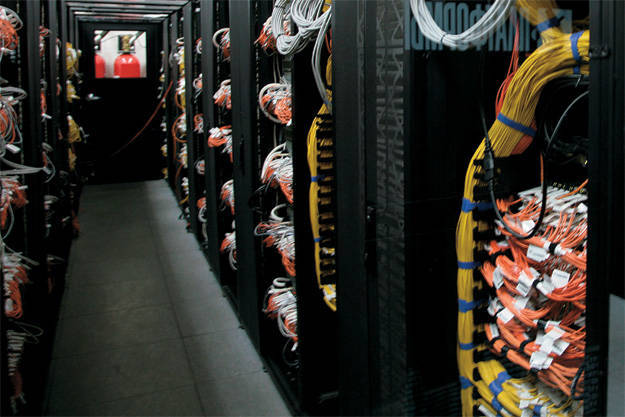
Supercomputer “Lomonosov”
The first call, warned of the problems that can arise from the supercomputer company, in collaboration with the West came during Dmitry Medvedev’s visit to Germany in 2011. Then, at a meeting with Angela Merkel expected to discuss cooperation in Germany and Russia in the field of supercomputing, in which, of course, was interested in the company and the “T-Platforms,” but as far as it became known, Merkel at the last moment refused to discuss precisely this point.
The second call was sounded in 2012. For many years “T-Platforms” worked closely with the Research Centre Jülich in Germany, one of Europe’s leading research centers, which has one of the largest supercomputers in the world.
A few years ago it was decided to cooperate with it by signing a communiqué.
But this proved to be difficult. One expert close to the company, said that after learning of such an intention, German Ministry of Science intervened and attempted to prevent the signing of the communiqué.
And, as far as is known, the order came from German Chancellor Merkel after a call by Secretary of State Hillary Clinton, who stressed that cooperation with Russia in such a sensitive area is not desirable.
At the end the Centre Jülich insisted on signing the communiqué and the contract to supply a supercomputer center went through.
As shown, according to the signed agreement on cooperation in 2013 “T-Platforms” has to deliver a prototype supercomputer with a capacity of 100 teraflops with air-cooling, and to develop a number of promising software technologies.
The system is assembled in the European office of the “T-Platforms.” Continuation of the project – setting up a multi petaflops system with water cooling system is scheduled for 2014.Despite these challenges, the company continued its active policy in Europe.
In 2012, the proposal of the “T-Platforms’ and Finnish supercomputer center CSC to build a prototype for a pan-European perspective supercomputer program” Partnership for the development of computing in Europe »(Partnership for Advanced Computing in Europe, PRACE) received the highest score in the evaluation of projects PRACE.
The first phase of the prototype in CSC was established and adopted in November 2012. In 2013, the installation must be carried out with the cooling system of “hot water” with the capacity of about 300 teraflops.
There are others European projects on cooperation with the company, i.e. with the second largest German Leibniz Computing Centre (Leibnitz Rechenzentrum) for research on energy-efficient supercomputer architectures based on the supplied “T-Platforms’ prototype system with water cooling.
But now all the projects in question.
True, hope remains still – Russian Foreign Ministry was contacted and some influential people with good connections in American political circles.
New COCOM
Regardless of the reasons that led to the inclusion of the “T-Platforms” in the U.S. black list, it is clear that the preservation of this dependence of Russian industry and the defense on the goodwill of the Americans and their allies, are making our technological sovereignty quite arbitrary.
And this dependence exists in almost all sectors of the innovation industry – from machine tools to microelectronic chips.Group President ELVIS Jaroslav Petrichkovich notes that the incident lies a systemic problem: “In today’s high tech world the Americans are using their technological achievements and have laid a lot of thresholds and constraints by which they can block undesired activities. And at least for the next decade, the world will have to live with these global constraints “.The Soviet Union, though it lagged behind the U.S. in the field of microelectronics, had almost the full range of technologies, and most importantly, had the electronic engineering allowing it to produce all the necessary equipment.
Now, all has changed and over the last 20 years the technology has been lost, industry research institutions languish or closed, and electronic engineering is almost completely lost.
A state program of the Russian Federation “Development of electronic and electronic industry for 2013-2015” is planned to achieve a level of technology of 45 nm chips in with a subsequent transition in 2025, the technology of 10 nm.
Unfortunately, the Program does not specify how to achieve those goals.
In principle, these can be done in two ways:
Purchase of equipment or design your own. The first way again paired with American control. Thus, the Russian company “Micron” negotiates purchase a factory to produce 90nm chips with the relevant U.S. structures.
Already producing chips on 28 nm technology are six companies, and a 22 nm – four companies. And experts predict further monopolization of chips production.
To expect under these circumstances, that someone wants to share technologies, is at least naive.
In addition, the value of a factory for the production of 10 nm chips are measured by tens of billions of dollars.The second way, given the state of Russian industry, is no easier.
In the journal “Fold nanopasyans” (see “Expert» № 4 for the year 2012), we cited an opinion of a leader of a group of companies “Micron”, the academic Gennady Krasnikov on how to solve the problem of Electronic Engineering:
He said: “There are two versions of industrial policy, including the field of electronic engineering.
If you have money, if there is a scientific research and the belief that our best design can win a substantial share of the market, we need to develop our own industry.
And if you do not have the necessary energy and money, it’s possible the second option – join an international alliance which are now working all of the world.
Although, if we want to participate in the alliance on equal terms, it still needs development and money.
Because if you invest money and resources, you have the same rights as others. But if you are doing work on other people’s money, you owe them for the work, but also intellectual property. “
Several years ago, Gennady Krasnikov, director of the Institute of Physics and Technology, RAS, Academician Alexander Orlikowski and Corresponding Member of Russian Academy of Sciences Nikolai Salashchenko petitioned the government with a proposal to create a program in Russia of Electronic Engineering, but he did not receive support.
It is appropriate to recall that the trading rules of dual-purpose (and almost all modern microelectronics fits this description) are covered by the so-called Wassenaar on Export Controls for Conventional Arms and high technologies (goods and technology “dual use”) of which Russia is part, and on them each State has to determine goods and technologies it is ready to sell and to whom.
In fact, this is a new form of the notorious COCOM.
And the Americans have a free hand to decide.
Another thing is that this practice of “employment ban” actually buries starry dreams of some of our politicians and public figures on the free exchange of goods and technology, fair competition between Russia and the West, and that it will help Russia to modernize its economy.
It may help, but up to a point, and the production of supercomputers is clearly not included.
By Valery Fadeev
Originator http://expert.ru/
www.topwar.ru/26203-russkomu-hayteku-ukazali-na-mesto.html
Translated from Russian.
By myfuamerica
Sorry, comments are closed on this post.