
FEATURED » WORLD
NATO took notice: Defense Industry of Belarus was saved from collapsing during downfall of USSR
April 1, 2013 · 0 Comments
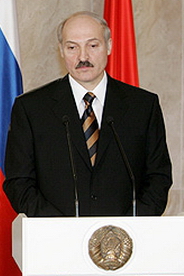
The president of Belorussia Lukashenko is probably not the example of a democratic leader, but don’t have all countries an emergency plan for bad times, which allows authoritarian rule to happen till the crisis is over.
Recently the elected mayor of Detroit in the USA was ousted by the governor in order to get the finances back on track. No body was calling for a embargo because of it, since it makes sense.
How about the freedoms in the U.S. since September 11th 2001, didn’t they suffer too?
When the USSR collapsed who would argue that it was not an emergency situation for hundreds of millions inhabitants?
The western consultants flooded Russia to advise how to organize the privatization of the once state owned industry, and contributed to the developing misery.
State agencies were dissolved, order broke down, the country was flooded in uncontrolled way with western products, which at once made it’s economy almost completely obsolete, remaining functional national corporations went to oligarchs for an “apple and an egg”, who in their terms corrupted the political establishment even more – short, the country was in disarray and lost not only it’s superpower status, but the ability to provide for millions of it’s citizens with basic necessities.
To blame the West for the events after the collapse of USSR only wouldn’t obviously reflect the true picture, though. They were just vultures on it’s pray.
President Jeltzin followed the pad of mindless “Westernization” and became for the country a second night mare after Gorbachev’s “Perestroika”, which should have been called rather “Perestroika without a concept”.
Both leaders didn’t meant harm, but due to lack of profound understanding of the underlying processes and any similar historic example of a transition from a “Planned Economy” to a “Free Economy” under fierce competition from outside, they allowed the complete disintegration of the systems in place.
One has to envision, that between 1990 and 2000 Russia’s economy took losses twice as much, as during the whole WWII – and that each year!!!
Putin stopped this process in 2000 and is more or less successfully reestablishing governmental agencies, police, the military, etc.
Obviously, this is a long way to go and given the specific traditions of corruption and disobedience of law many obstacles are still ahead.
But the direction is set and the “train” is moving.
It is understood, that the former USSR or Russia in this regard is being perceived as a threat to the western countries since centuries, since if industrialized, it has the potential to be a super power yet again, having both, the resources and the industry.
This is the reason, why Russia is being attacked for every possible reason, be it valid or not, but similar circumstances in other countries remain in western media unnoticed.
(In this regard Russia is similar to Israel, which is always the “bad” guy, but never the Arab dictators around it, since they have the crude oil.)
Under these conditions it remains very difficult for Russians, as well for outsiders, to distinguish between the propaganda noise the western media is creating and real problems in existence.
Once the motivation of all NATO members is disclosed – namely to prevent Russia to industrialize, and even more, to neutralize the only country in the world to be able to provide real balance to the western military might, all the deeds on the political world stage become clear and one can see through them like through a glass of water.
That’s why Russia is closing in to the western countries, and similarly as they do, disallows foreign funding of “Nongovernmental Organizations”, which often, instead of to provide real help, are attempting to destabilize it.
Therefore, if you hear next time in the western press how bad the Belorussian president is, but won’t read in the same article about similar deeds of presidents of other countries, or for example even about the Saudi Arabian dictator, or any other allies of the NATO with bad manners, tell your self: It’s just the noise the NATO propaganda machine is producing, and probably they don’t like Lukashenko, because he preserved the military industry from collapsing, which in terms helps Russia to reestablish it’s status faster.
There is a saying: “The dogs are barking and the caravan is moving”.
Who is next to underestimate Russia once again, Napoleon, Hitler, …
By Mr.Reason.
Info on Belarus:
Belarus ranks among the most developed of the former Soviet states, with a relatively modern – by Soviet standards – and diverse machine building sector and a robust agriculture sector. It also serves as a transport link for Russian oil exports to the Baltic states and Eastern and Western Europe. The breakup of the Soviet Union and its command economy has resulted in a sharp economic contraction as traditional trade ties have collapsed. At the same time, the Belorussian Government has lagged behind most other former Soviet states in economic reform; privatization has barely begun; the agriculture sector remains highly subsidized; the state retains control over many prices; and the system of state orders and distribution persists. Meanwhile, the national bank continues to pour credits into inefficient enterprises, fueling inflation and weakening incentives to improve performance. The government is pinning its hopes on reintegration with the Russian economy, but such a path would only partially restore traditional trade ties. Until economic reform is embraced, Belarus will continue in its economic morass.
In the years under Soviet power the economy of Belarus had been developing as an integral part of a single national-economic complex of the USSR. Before the dissolution of the Soviet Union Belarus had been among the most economically and socially developed Republics. With its territory being less than 1 per cent of the overall territory of the USSR Belarus produced more than 4 per cent of the total national income. Its proportion in the output of certain important types of production was even greater. However, the structure of industry that had been formed as a result of rigid centralized planning made Belarus dependent on supply of large volumes of raw materials and power resources. Production of means of production and military products prevailed.
Until recently, the radio-electronic industry of Belarus was mainly related to military engineering. Largely for this reason, the majority of radio engineering and electronic enterprises have modern productive-technological bases and highly skilled staffs of scientists and experts. Here, as earlier, after practically completed conversion, one fourth of the total volume of machine-building production is made. The radio-electronic industry of Belarus within the framework of the uniform economic complex of the USSR specialized mainly in manufacturing computer facilities, mobile automated control systems, optical devices, communication facilities and systems, air equipment, telemetering equipment, products of electronic engineering and other elements of armaments and military engineering.
Industries employ about 40% of labor force and produce a wide variety of products including (in percent share of total output of former Soviet Union): tractors (12%); metal-cutting machine tools (11%); off-highway dump trucks up to 110-metric-ton load capacity (100%); wheel-type earthmovers for construction and mining (100%); eight-wheel-drive, high-flotation trucks with cargo capacity of 25 metric tons for use in tundra and road-less areas (100%); equipment for animal husbandry and livestock feeding (25%); motorcycles (21.3%); television sets (11%); chemical fibers (28%); fertilizer (18%); linen fabric (11%); wool fabric (7%); radios; refrigerators; and other consumer goods
After an initial outburst of capitalist reform from 1991-94, including privatization of state enterprises, creation of institutions of private property, and entrepreneurship, Belarus under Lukashenko has greatly slowed its pace of privatization and other market reforms, emphasizing the need for a “socially oriented market economy.”
The economy remains centrally planned, and is primarily industrial, with industry accounting for approximately half of economic output. Primary industrial products include machine tools, tractors, trucks, and consumer durables. The majority of workers are employed in the state industrial and state agricultural sectors. The authorities claim that the gross domestic product (GDP) grew by 4 percent in 2001, but independent analysts asserted that all growth was the result of the accumulation of noncompetitive goods in inventories, fueled by continued massive credits to the debt-ridden state sector. Officials claimed that per capita GDP was slightly more than $2,000 (2,4 million rubles), but little of that growth resulted in real economic gain for the population. In the state sector wages were lower than the national average and wage arrears were chronic. Although the unreliability and unavailability of official statistics makes it difficult to measure macroeconomic conditions, living standards for many segments of society continued to decline. Residents of small towns and rural areas, where incomes are particularly low, sustained themselves through unreported economic activity and subsistence farming.
Belarus’s large defense industry was severely hit by the country’s cutbacks in imports of fuels and raw materials as well as by decreased demand for military products across the former Soviet Union in general. Because Belarus is paying higher prices for its fuels and raw materials, the cost of its products has increased, prompting a decrease in purchases not only by Russia but by other former Soviet republics as well. Conversion to civilian industry has not been quick or successful, as is the case across the former Soviet bloc. The defense industry in Belarus hopes Russia will give it more business now that Belarus is paying some of the costs of maintaining Russian troops on Belorussian soil. Belarus has also tried to increase its arms markets.
The area of greatest concern continues to be the link between the Belorussian MOD, the sale of arms, equipment services to, and the training of personnel from States of Concern. Included in this category (but not limited to) are the sales of weapons to Libya and Syria, along with reported weapons transfers, upgrades of Iraqi equipment (S-300 system) and air defense training of Iraqi service members.
As a matter of policy, the U.S. Government currently does not encourage U.S. companies to invest in Belarus. Belarus’ continuing problems with an opaque, arbitrary legal system, a confiscatory tax regime, cumbersome licensing system, price controls, and lack of an independent judiciary create a business environment not conducive to prosperous, profitable investment. In fact, several investors into Belarus have left in recent years, including the Ford Motor Company. The investment climate is exacerbated by the fact that the IMF and the World Bank have had to cancel or suspend their programs of cooperation with Belarus in recent years.
Iran is actively seeking military hardware in the CIS, particularly Russia, Kazakhstan, Ukraine, Kyrgyzstan, and Belarus. Iran has been trying to develop a surface to air missile defense and has various rockets, but has been unable to create a centralized control. It also has an ailing air force of Russian MIGs and bombers that need upgrading. Belarus has a military modernization industry that has had much experience in developing and centralizing a surface to air defense system and modernizing Russian equipment. After the fall of the Soviet Union, other CIS nations’ infrastructure fell apart, but Lukashenko made sure it was preserved in Belarus, if not upgraded. The young specialists had all moved away, but the old timers were still around to continue developing and modernizing military technology. Belarus had the knowledge e Iran needed and Iran had what Belarus wanted – large oil deposits, nuclear energy development, and a market for Belorussian military technology.
By myfuamerica
Sorry, comments are closed on this post.